5 Important Warning Signs Your Child Needs a Pediatric Dentist in Pune
Many parents assume that a child’s milk teeth do not require specialized attention because they are temporary. In clinical practice, dentists often find that treating primary teeth is actually vital because they hold the precise space needed for future permanent teeth. If milk teeth decay and are lost early, it can cause the permanent teeth to erupt in a crowded or misaligned manner. Recognizing when a child requires the care of a specialist pediatric dentist can prevent long-term orthodontic complications and systemic health issues.
Urban and semi-urban families across Pune face evolving lifestyle changes, including easier access to sticky, sugary snacks, processed foods, and refined carbohydrates. These dietary shifts, combined with a traditional focus that sometimes prioritizes general medicine over preventive dentistry, often leave young children vulnerable to rapid oral health decline.
Understanding the specific warning signs that necessitate a visit to a specialist can help families make informed healthcare choices. Here are five critical indicators that your child should see a pediatric dentist.
1. Persistent Tooth Sensitivity or Pain During Meals

When a child regularly complains of discomfort while eating hot, cold, or sweet foods, it usually indicates that the protective enamel layer of the tooth has been compromised. Children might not always use the word “pain”; instead, they might chew exclusively on one side of their mouth or suddenly refuse foods they previously enjoyed, such as cold milk or traditional sweets.
If a child expresses distress during standard meals, a simple visual inspection at home might not reveal the micro-cavities forming between the teeth. Early intervention by a pediatric dentist can resolve this through simple fillings or protective sealants before the decay reaches the nerve.
2. Visible White Spots or Discolouration on the Enamel

A common misconception among parents is that cavities always look like dark brown or black spots. In reality, the very first sign of dental decay often appears as chalky white spots near the gumline. These spots signify areas where the enamel is losing its mineral content due to plaque acids.
If left unaddressed, these white areas weaken further, breaking down into distinct physical cavities that turn brown or black, as seen in advanced stages of early childhood caries. Catching the problem at the white-spot stage allows a pediatric dentist to apply professional topical fluoride treatments to remineralise the enamel, avoiding the need for invasive drilling or structural fillings entirely.
3. Swollen, Bleeding, or Red Gums
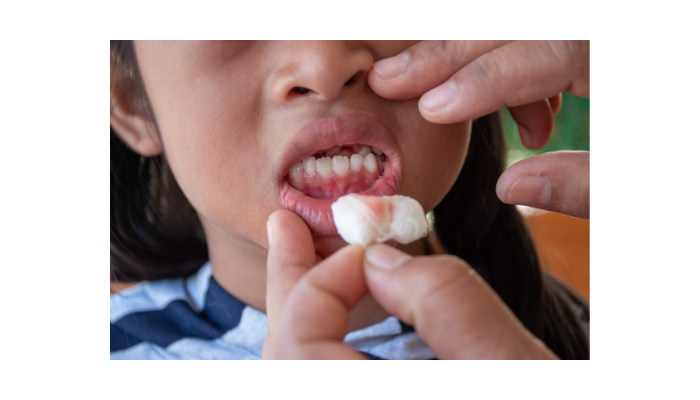
Healthy gums should always look firm and pale pink. If you notice a red border along your child’s teeth, or if their gums bleed during routine brushing, it is a clear sign of gingivitis (early-stage gum disease caused by plaque accumulation).
In India, family diets often include soft, carbohydrate-rich staples that can easily adhere to a child’s teeth. If daily brushing isn’t meticulous, bacteria multiply rapidly along the gumline. A pediatric dentist can perform a gentle, child-specific cleaning and guide the family on proper brushing techniques to reverse the inflammation before it damages the underlying bone.
4. Chronic Bad Breath (Halitosis) That Persists After Brushing

Occasional morning breath is normal, but chronic bad breath that remains even after brushing and tongue cleaning usually points to an underlying issue. This persistent odour is typically caused by large populations of oral bacteria living within deep, hidden cavities, or collecting in hard-to-reach pockets around inflamed gums.
Sometimes, persistent halitosis in younger children can also be linked to chronic tonsillitis or a small object habituated into the nasal passage, but the mouth is always the primary place to check. A pediatric dentist has the diagnostic tools to locate hidden bacterial reservoirs that normal brushing cannot resolve.
5. Prolonged Thumb-Sucking or Tongue-Thrusting Habits

While thumb-sucking is a natural self-soothing reflex for infants, it can become problematic if it persists past the age of three or four. The constant pressure of a thumb or fingers against the roof of the mouth can alter the shape of the developing jawbone and cause the upper front teeth to tilt forward.
Parents are sometimes surprised to learn that these prolonged habits can cause an “open bite,” where the front upper and lower teeth do not meet when the mouth is closed. A pediatric dentist in Pune can track jaw development over time and introduce gentle, habit-breaking appliances or behavioral techniques to avoid severe orthodontic issues later in childhood.
Understanding Specialized Rules in Pediatric Dentistry
When navigating a child’s oral development, pediatric dentists often reference specific clinical guidelines and observations to help parents understand milestones and safety measures.
| Rule / Guideline | Practical Explanation for Parents |
| The Rule of 7 | A clinical guideline recommending that every child should have an initial orthodontic evaluation by age 7. By this time, the first permanent molars have erupted, establishing the back bite and allowing a specialist to detect subtle jaw-growth anomalies early. |
| The 3-3-3 Rule for Teeth | A preventive home-care framework instructing families to brush 3 times a day, for 3 minutes each time, and to ensure they clean all 3 surfaces of the teeth (outer, inner, and chewing surfaces). |
| The Rule of 4 | An educational baseline for tracking early tooth eruption: for every 4 months of age, a child typically erupts approximately 4 new primary teeth, starting with the lower central incisors around 6 to 10 months. |
| The 3-3-3 Rule for Infections | A medical safety timeline for managing acute dental infections: if a child is prescribed antibiotics for a dental abscess, parents should look for initial improvement within 3 days, expect full resolution of acute symptoms within 3 weeks, and ensure a clinical follow-up is completed by 3 months to address the tooth’s root cause. |
Conclusion
Addressing your child’s dental health early sets the foundation for a lifetime of healthy smiles. Recognizing subtle shifts in chewing habits, tooth color, or gum health allows for conservative, pain-free interventions that keep developmental milestones on track. If you notice any of these warning signs or simply want to schedule a routine preventive check-up, establishing a relationship with a dedicated specialist can make all the difference.
For personalized pediatric guidance and expert care, feel free to connect with Wonder Smile Dental Clinic in Pune to schedule a consultation with our specialized team.
Frequently Asked Questions (FAQ’s)
What is the difference between a general dentist and a pediatric dentist?
Pediatric dentists complete an additional two to three years of specialized postgraduate training beyond standard dental school. Their education focuses exclusively on child psychology, growth and development, management of developing jaws, and specialized behavioral techniques designed to make dental visits completely anxiety-free for toddlers and children.
At what age should a child first visit a pediatric dentist?
Global dental associations and clinical protocols recommend that a child should have their first dental visit when their first tooth erupts, or by their first birthday at the latest. This early visit is primarily educational, allowing the dentist to evaluate jaw development, discuss proper cleaning techniques with parents, and establish a comfortable “dental home” for the child before any painful problems arise.
Are milk teeth really that important if they are going to fall out anyway?
Yes, primary teeth are absolutely essential for several critical functions. They allow your child to chew nutritious foods properly, speak clearly during crucial language-development years, and act as natural space maintainers that guide permanent teeth into their correct positions. Neglecting decay in milk teeth can lead to painful infections that can directly damage the developing permanent teeth waiting underneath them.